

Introduction
I used to dream of going on a silent retreat. Just a few days away from the beautiful chaos of family life — no alarms, no school runs, no snack negotiations. I pictured a quiet cabin in the woods, long walks, and nothing but stillness.
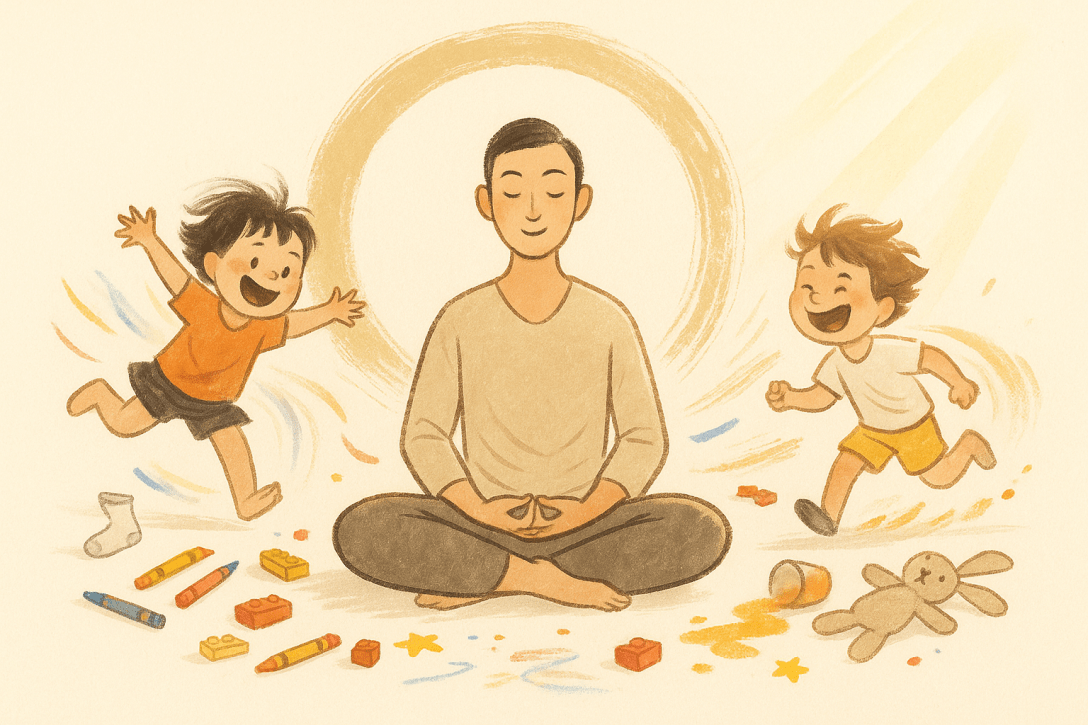
But one evening, while wiping spaghetti sauce off a proud toddler’s face and negotiating toothbrush terms with an older sibling, it struck me: what if my real retreat is already here? What if my greatest Zen teachers are the ones leaving Lego on the floor and peanut butter on the door handle?
Parenthood has a way of turning the tables. We enter thinking we’ll be the ones guiding our children, only to discover that they’re the ones handing us the lesson plans — lessons in presence, acceptance, curiosity, and even letting go of ego. Over time, I’ve realised my kids have quietly become my Zen masters, showing me what no meditation app or workshop could.
Here’s what they’ve taught me.
Lesson 1: Beginner’s Mind – The Joy of Not Knowing
My children ask “why?” like it’s their job. A trip to the mailbox becomes a field expedition. A cardboard box transforms into a spaceship.
In the past, I felt pressured to always have the right answer. Now, I sometimes respond with, “I’m not sure — what do you think?” Suddenly we’re co-explorers, seeing the world with fresh eyes. This is the Zen concept of beginner’s mind — meeting each moment without preconceptions, open to what it has to show us.
As adults, we accumulate so much “knowing” that we stop really seeing. My children invite me to unlearn just enough to notice the galaxy hiding inside a soap bubble or the moon reflected in a puddle.
A quick practice
Next time your child asks a question you can’t answer right away, resist the urge to Google. Spend a minute wondering together. Make a guess, look closer, and let curiosity be enough — for now.
That curiosity naturally flows into the next lesson they’ve taught me — one that happens not in grand moments, but in the small, everyday ways they pull me into the present.
Lesson 2: Living in the Now – Mindfulness by Play
Children are masters of the present moment. Watch a child paint and you’ll see it: no past, no future, just the brush, the colour, and their giggles.
I’ve had my mindfulness tested during bedtime stories. My mind would wander to tomorrow’s tasks until one of my kids asked, “Are you here?” That question is better than any meditation bell.
Alan Watts once said the real secret of life is to be fully engaged with what you’re doing in the here and now — and instead of calling it work, to realise it is play. My kids live that truth without even knowing it. A ladybug on the path is not a distraction, it’s an invitation. Kneeling beside them to watch it climb a blade of grass, I feel my shoulders drop and my breath slow.
A quick practice
Choose one daily routine — brushing teeth, making sandwiches, tying shoes — and do it not to be done, but just being in the doing. Be aware of the journey instead of focusing on the result.
But being present is easier when things go smoothly. The real test of my Zen lessons comes when control slips through my fingers — which, in parenting, is often.
Lesson 3: Letting Go and Acceptance – Learning to Float
Parenting quickly reveals the illusion of control. You can plan the perfect nap schedule only to have it gleefully ignored. You can set the table beautifully and walk in to find peas rolling across the floor like marbles.
Zen offers a different approach: meet what is, then move wisely. Alan Watts compared it to swimming — grip the water and you sink; relax and you float.
I was reminded of this one afternoon on our terrasse. We have a big sandbox, and I was neatly brooming the sand together to put it back. My son, armed with a rake, drove it straight through my tidy pile, sending a long trail of sand across the floor. My past self would have focused on the outcome and been annoyed by the delay. But that day, I was moving the sand simply for the sake of moving the sand. As he spread it out again, I smiled and silently thanked my two-year-old Zen master.
A quick practice
When something derails your plan, name it out loud without judgment: “Spill happened.” Then ask, “What’s the next small helpful move?” Do just that — one move, one breath.
And sometimes, letting go opens the door to something even lighter — rediscovering the playfulness we often lose as adults.
Lesson 4: Spontaneity and Playfulness – Dropping the Ego’s Guard
My kids are professionals at joy. They invent parades, assign me dragon roles, and turn dinnertime into a café with questionable service.
I used to hover at the edge, too busy or too “adult” to join in. But the moment a small hand pulled me into the game, my inner critic quieted down. For a few minutes, I wasn’t a parent juggling tasks — I was just there, laughing.
Watts once said, “Man suffers only because he takes seriously what the gods made for fun.” When I join my children’s silliness — a dance-off in the kitchen, splashing in puddles — I see how quickly joy returns when ego steps aside.
A quick practice
Schedule a 3-minute “ridiculous break” each day. Put on a song, copy your child’s moves, or make the silliest face you can.
These lessons don’t come in quiet, perfect moments. Sometimes they arrive in the middle of chaos — which is why my most profound retreat happened without leaving home.
The Retreat I Found at Home
For years, “Go on a silent retreat” sat on my wish list. But the right moment never came.
One Saturday, after a rough night’s sleep, I made coffee before anyone else was awake. I sat at the kitchen table, breathing in the stillness. Then I heard tiny footsteps.
“Can I sit with you?” my child asked. I slid my mug aside.
We watched the steam curl, a sunbeam crawl across the floor, dust motes drifting like slow snow. After a minute, two small hands cupped my face. “This is nice,” they whispered.
It was the gentlest retreat I’ve ever had — not silent, not scheduled, but deeply present. I realised then: retreat doesn’t always mean leaving. Sometimes it means arriving, right where you are, with the teachers you’ve been given.
Closing
My children give me a dozen dojos every day: a puddle, a puzzle, a pause between pages — even a rake through a neatly swept pile of sand.
In them, I practice beginner’s mind, presence, letting go, and play. I get it wrong, repair, and try again. And each time, something softens.
If you’ve been longing for space, notice the small invitations already in your home. Treat them like bells. Answer a few each day.
Because in raising our children, we are also raising ourselves — toward a steadier attention, a kinder voice, and a lighter step. The teachers are here. Class is in session. And the classroom is beautiful, messy, and very much alive.
 Weber Strategies